










Understanding Burn in TCGs
Hello, everyone!
We've seen many new Lorcana players, both due to the game's expansion and the hype surrounding the upcoming set, Fabled , which will also reprint many cards from the first 4 sets.
With that in mind, today we're going to highlight a deck with a very straightforward game plan: Ruby-Amethyst Burn!
If you're unfamiliar with the term, Burn Deck is a TCG slang for a strategy in which you use cards that directly attack or advance your win condition. Older card games, such as Magic: the Gathering, use life points as a win condition—or, rather, reducing the opponent's life points to zero. Many cards can be used to deal damage directly to life points, and these were commonly fire-related cards: Incinerate, Fireball, and the like. This is how the archetype was nicknamed Burn Deck.
But how does this fit into Lorcana? Well, the objective of the game is to reach 20 Lore points, and the most common way to do this is to Quest with your characters. However, there are some cards and abilities that gain Lore directly, without needing to Quest at all! So, with this plan in mind, let's talk about our deck for today!
Ruby-Amethyst Burn - Decklist and Gameplan
So, as we mentioned, today's deck pairs Ruby ink with Amethyst ink, and a lot of cards that generate Lore directly. This is the list:

The game plan is to be a fast, aggressive deck, that wants to generate as much Lore as possible with its early characters, and then finish the 20 Lore by gaining the remaining points directly, without relying on Quest.
Most of the characters are low-cost and somewhat fragile. To make up for it, they can generate Lore directly, or they can make life difficult for the opponent by being Evasive, or they can allow you to draw cards, increasing your chances of accumulating enough Lore gain to outright win the game.
In fact, most of the cards in the list cost one or two ink points—thirty-six of the sixty cards in the deck. In other words, sequencing will be important, as some cards are better designed for use in later turns, even though they cost little ink.
Let's analyze each card and understand how they contribute to our plan.
Early Lore Characters
It would be incredibly difficult to win a game of Lorcana without any Lore from Quests, as there are not enough burn cards efficient enough to completely bypass using characters.
Therefore, the idea in the early turns is to focus on establishing small, but preferably resilient, Lore generators.
Moana and Pascal, at 1-cost, are great examples: Moana has strong stats for a 1-cost, and Pascal has Evasive if you control any other character—even another Pascal! It's almost a combo to control two of them, as you'll essentially have a 1/1 Evasive character for 1 ink.
On that same page, Wendy, at 2-cost, is also Evasive, and will receive bonus stats if you control either Moana or another Wendy! It's no wonder we use four of each. Wendy also allows Moana to challenge other characters, though you rarely intend to do so—it's better to continually generate Lore with Moana and let your opponent waste resources to deal with her!
Magic Broom and Kuzco are characters that draw cards when they leave the board, which is important for maintaining resource parity. You'll be very happy if they can gain even 1 Lore and then draw you a card; with Magic Broom, you control exactly when this happens, while Kuzco stays on the board generating value until your opponent deals with him.
Finally, Tinker Bell is another Evasive character, making it difficult for your opponent to interact. It will generate 2 Lore per turn, so a quick response from the opponent is required, which limits other plays by them.
Direct Lore Generators
While the characters in the previous section are mainly used for Quest, in this sectione we'll talk about the ones capable of generating direct Lore, and thus accelerate our win condition.
At cost 2, Honeymaren relies on the opponent having an exhausted character; therefore, save it for such moment. If the opponent has few characters, remember that Honeymaren can be used as ink!
Similarly, at cost 4, Super Goofy also relies on the opponent's characters, and if you notice that the opponent is playing around Goofy, use it as ink and continue developing your game!
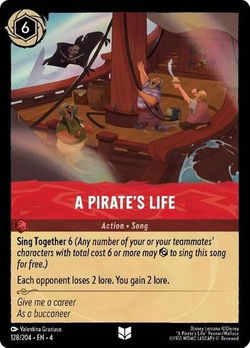
Back to the 3-cost, Gloyd and White Rose are almost the same, with Gloyd having weaker stats but hitting the opponent's Lore to compensate. Since they both are 3-ink characters, they are also important to help sing A Pirate's Life, which helps you save a few cards in hand—no need to get to 6 ink. Therefore, if you have the song in hand, value these characters accordingly—don't expose them to an unnecessary challenge from the opponent!
Finally, Merlin at 4-cost brings a sort of inevitability, since it will generate at least 2 Lore either way. One point immediately upon being played, and another one if your opponent deals with him—if they don't, you can use Quest with and gain another 1 Lore anyway. Being a 4-cost, it's also a great help for singing A Pirate's Life, and since it generates 1 Lore if it gets removed, you're not as worried about exposing it to challenges.
Actions
All of the sixteen actions on the deck can generate Lore directly, living up to the Burn Deck archetype!
Thievery is the only 1-cost, but that doesn't make it any less important. Along with Gloyd, it interacts with your opponent's Lore, often giving you a little breathing room to take the lead in the Lore race.
Gathering Knowledge is the deck's best value play, generating 2 Lore for 2 ink. Even though it's cost-effective, you don't want too many in your starting hand, as it's non-inkable and doesn't impact the board. You want to find them more in the midgame, when you just need to generate the final Lore points and close out the game.
This Is My Family, even though it's non-inkable, has good value to it because it not only draws a card, but itself is also a song! Characters like Kuzco or Northundra can occasionally sing it, thus saving you ink on a turn where you need to chain together lots of cards or if looking for something specific. Of course, ideally, you'll use it the same way as Gathering Knowledge, and draw cards that will help close out the game.
Finally, A Pirate's Life has a very high cost, and you want to avoid, if possible, having to use six cards for ink. Try to use the Sing Together ability, and combine characters like Gloyd, White Rose, Merlin, and Kuzco to play this card. Of course, its value ends up being diminished—after all, you're not Questing with the characters—, but you gain a tempo advantage and, indirectly, more cards in hand, since you save on cards going to the inkwell.
Generally speaking, if you don't have an efficient way to play A Pirate's Life, use it as ink! This tip also applies to Thievery, although its lower cost makes it much easier to play.
Conclusion
With many new players entering the world of Lorcana, it's always good to have accessible, cost-effective decks that have a straightforward game plan, since they make it easy for players to learn how to sequence their plays.
Such was the goal of today's deck: a reasonably budget list that allows beginners to have fun and explore some of the game's mechanics, while having a competitive enough deck to win some games.
Hope you enjoyed it! Leave your feedback in the comments below!
Cheers, and see you next time!





 Inicia sesión y únete a la conversación
— Comentarios 0
, Reacciones 1
Se el primero en comentar